
WHO technical consultation on research requirements to support policy recommendations on highly sensitive point-ofcare diagnostics for P. falciparum malaria: meeting report
Collaborator(s): MESA, Spain
Published: 19/10/2018
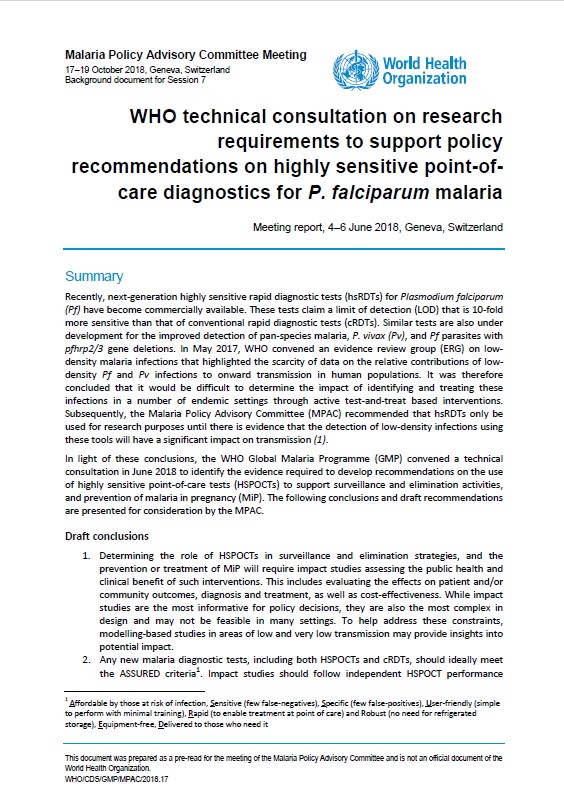
Recently, next-generation highly sensitive rapid diagnostic tests (hsRDTs) for Plasmodium falciparum (Pf) have become commercially available. In May 2017, WHO convened an evidence review group (ERG) on low-density malaria infections that highlighted the scarcity of data on the relative contributions of low-density Pf and Pv infections to onward transmission in human populations. It was therefore concluded that it would be difficult to determine the impact of identifying and treating these infections in a number of endemic settings through active test-and-treat based interventions. Subsequently, the Malaria Policy Advisory Committee (MPAC) recommended that hsRDTs only be used for research purposes until there is evidence that the detection of low-density infections using these tools will have a significant impact on transmission. In light of these conclusions, the Global Malaria Programme convened a technical consultation in June 2018 to identify the evidence required to develop recommendations on the use of highly sensitive point-of-care tests (HSPOCTs) to support surveillance and elimination activities, and prevention of malaria in pregnancy.
Published: 19/10/2018
THEMES: Diagnostics
Related Resources