
Monitoring, Evaluation, Accountability And Learning (MEAL) – Online Post Graduate Diploma Programme
Monitoring and Evaluation have been considered to be an essential component of project management. It plays an integral role in helping project implementors to explicitly demonstrate that government or donor aid spending in a given project or intervention is being used effectively while meeting the expected standards. More importantly, the expenditure should help in meeting the set objectives of the chosen intervention. To achieve this, there has been a rising demand for “Result-Based Management” (RBM) in many projects as institutions lean towards the adoption of “Results Framework,” which is a key tool in monitoring and evaluation.
Despite the unprecedented success of RBM in communication of results from such projects, there are some inadequacies which have emerged. RBM has not been able to provide enough evidence on how it incorporates stakeholder participation, information sharing, learning, accountability and organizational transparency. This has created the urge to rethink of a new approach to M&E. Firstly, M&E is defined as the process of collecting, storing, analyzing and transforming data to form strategic information that can be used to make informed decisions for effective policy formulation, advocacy and program management.
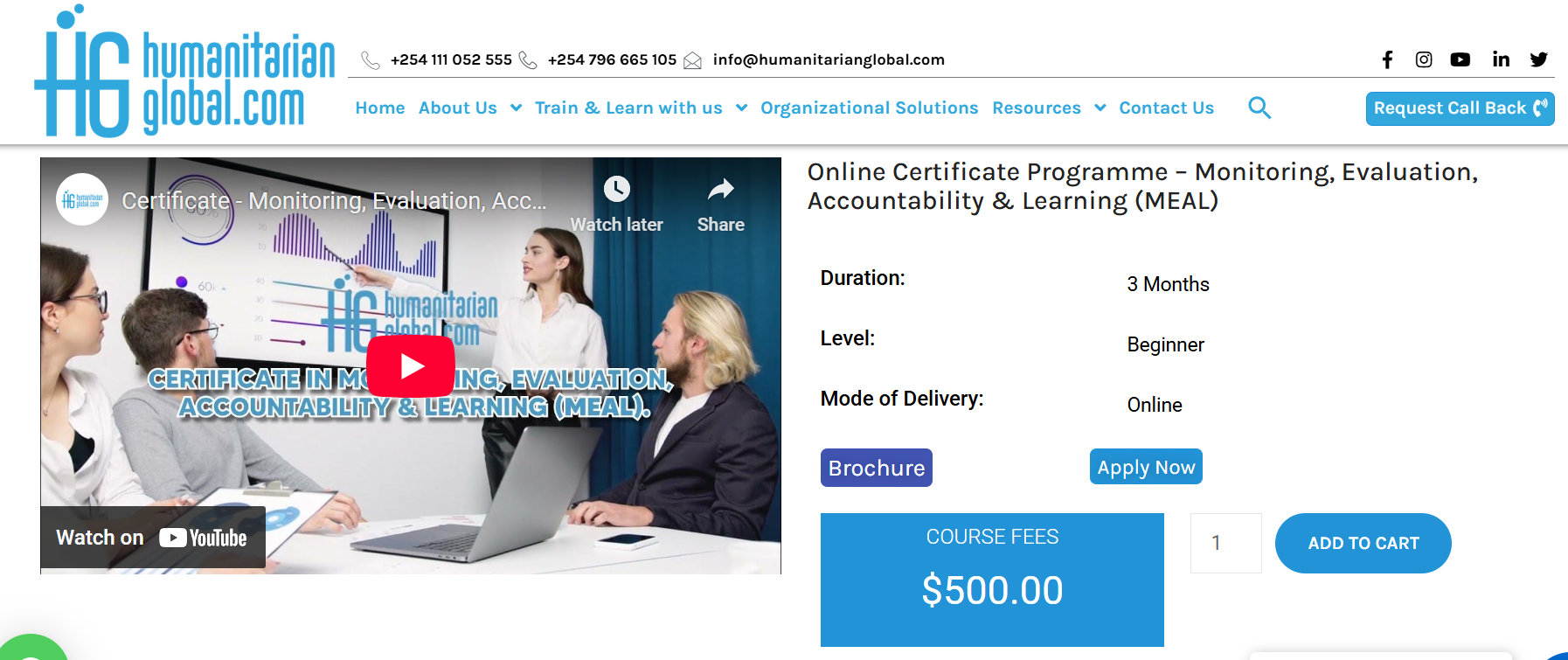
Therefore, to address the inadequacies in the earlier approach to M&E, a new and advanced programme has been developed which incorporates Accountability and Learning aspects. Humanitarian Global has been at the forefront of embracing this change and we are happy to offer an Online Post Graduate Diploma Professional Course in MEAL that will equip you with expert-level skills to help you cope with new demands in project management.
Course Outline
1.0 Module 1 – Evaluation Designs
- Experimental Design
- Quasi-experimental Design
- Non-Experimental Designs
- Comparison Matrix
2.0 Module 2 – Evaluation Approaches
- Feminist Evaluation
- Transformative Evaluation
- Real World Evaluation & Realist Evaluation
- Equity-Focused Evaluation & Developmental Approach to Evaluation
3.0 Module 3 – Preparing for an Evaluation
- Initial Steps
- Constructing a Theory of Change
- Developing a Results Chain
- Specifying Evaluation Questions
4.0 Module 4 – Impact Evaluation
- Evidence-Based Policy Making
- What Is Impact Evaluation?
- Prospective vs. Retrospective Impact Evaluation and Efficacy Studies and Effectiveness
Studies
- Deciding Whether to Carry Out an Impact Evaluation
5.0 Module 5 – Causal Inference and Counterfactuals
- Causal Inference
- The Counterfactual
- Estimating the Counterfactual
- Two Counterfeit Estimates of the Counterfactual
6.0 Module 6 – Instrumental Variable
- Evaluating Programs When Not Everyone Complies with Their Assignment
- Types of Impact Estimates
- Imperfect Compliance
- Randomized Promotion as an Instrumental Variable
7.0 Module 7 – Difference-in-Differences
- Evaluating a Program When the Rule of Assignment Is Less Clear
- The Difference-in-Differences Method
- How Is the Difference-in-Differences Method Helpful?
- Limitations of the Difference-in-Differences Method
8.0 Module 8 – Matching
- Constructing an Artificial Comparison Group
- Propensity Score Matching
- Combining Matching with Other Methods
- Limitations of the Matching Method
Final Project
You can find the beginner level of Monitoring, Evaluation, Accountability & Learning (MEAL) course via this link.

THEMES: Capacity Building | Monitoring & Evaluation
Related Resources