

Gene drives for population suppression of the malaria mosquito
Johns Hopkins Malaria Research Institute (JHMRI), United States; Imperial College London, United Kingdom
Published: 20/09/2021
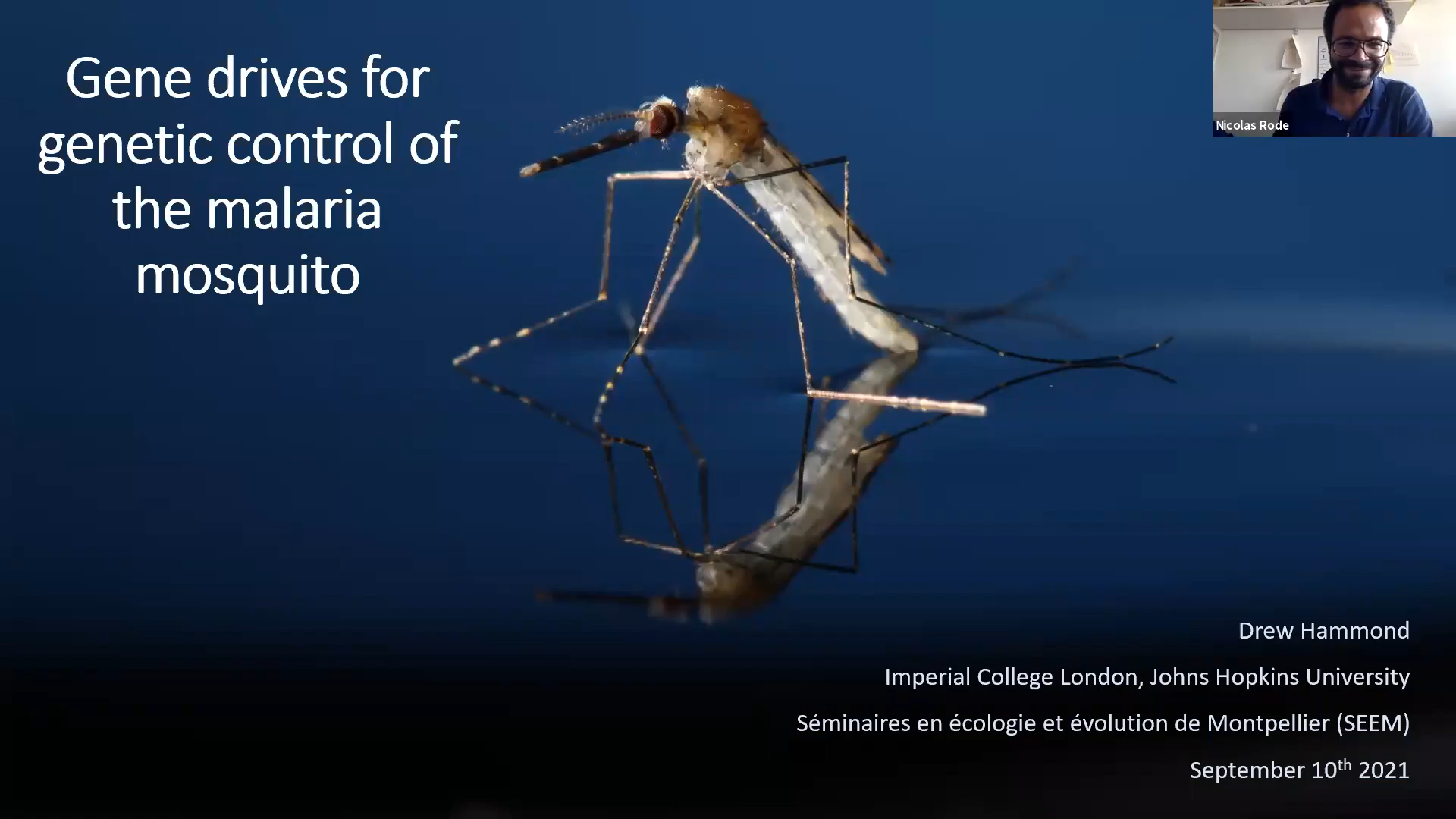
This is an Andrew Hammond lecture at the Les Séminaires d’Ecologie et d’Evolution de Montpellier/The Montpellier Ecology and Evolution Seminars (SEEM).
Gene drives are a special type of genetic modification that can bias their own inheritance, allowing them to spread throughout an entire insect population within a couple of years. They can be designed to suppress the number of malaria mosquitoes by making female mosquitoes infertile. This strategy is complimentary to existing vector control, whilst having the advantage of being cheap, fast-acting and entirely self-sustaining – as it is the mosquitoes do the work of spreading the intervention. In 2015 the first proof-of-principle gene drive in the mosquito was demonstated, however they failed to spread when released into small, caged populations because of drive-resistant mutations. By investigating how these mutations form, and what propels their spread, it was possible to develop a second-generation design that can spread in small-caged testing without inducing resistance. To bridge the gap between lab and field testing, further releases were conducted in a custom-built, large-cage testing facility designed to simulate field conditions. These conditions induced complex behaviours not observed in small-scale testing such as swarming, resting and egg-laying. Complete population suppression was observed in all replicates within one year of release – demonstrating the first semi-field testing of gene drive technology. These results are a crucial stepping-stone towards the use of gene drive for control of malaria in Africa.
Published: 20/09/2021
THEMES: Genetics and Genomics | Vector Control
Related Resources