
Infectious Disease Modelling Specialization
Mathematical modelling is increasingly being used to support public health decision-making in the control of infectious diseases. This specialisation aims to introduce some fundamental concepts of mathematical modelling with all modelling conducted in the programming language R – a widely used application today.
The specialisation will suit you if you have a basic working knowledge of R, but would also like to learn the necessary basic coding skills to write simple mathematical models in this language. While no advanced mathematical skills are required, you should be familiar with ordinary differential equations, and how to interpret them. You’ll receive clear instruction in the basic theory of infectious disease modelling alongside practical, hands-on experience of coding models in the programming language R.
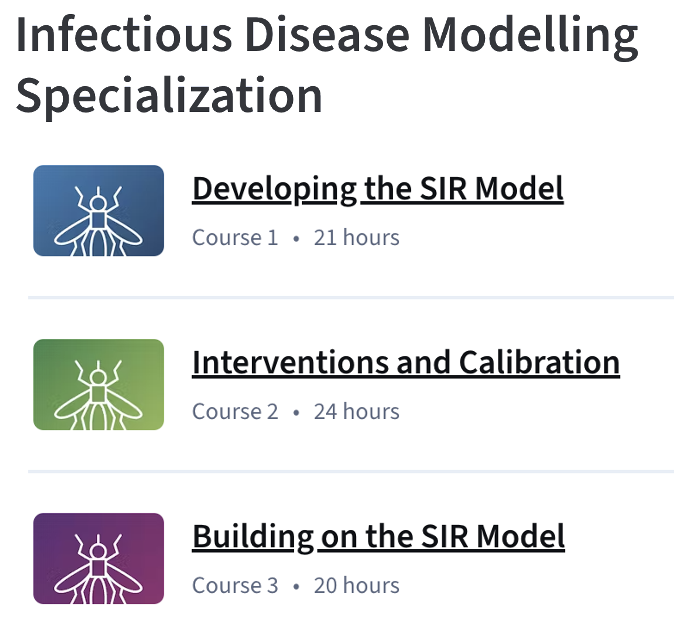
This specialization is a 3 course series:
- Developing the SIR Model
- Interventions and Calibration
- Building on the SIR Model
- Construct valid mathematical models capturing the natural history of a given infectious disease.
- Implement a mathematical model in R, calibrating it against epidemiological data in order to estimate key model parameters
- Use a calibrated model to create model projections for different intervention scenarios
- Explain the strengths and limitations of a mathematical model in relation to given research and policy questions
This course is available in English (Original), Deutsch (Auto), हिन्दी (ऑटो), Русский (авто), Svenska (auto), 한국어 (자동), Ελληνικά (αυτόματο), Português (Brasil) (auto), Italiano (auto), Français (aut.), Español (auto), 中文(简体) (自动), العربية (آلي), ไทย (อัตโนมัติ), Українська (авто), 日本語 (オート), Bahasa Indonesia (otomatis), Polski (automatyczny), Nederlands (auto), Türkçe (otomatik), Қазақша (auto).
*Access to this course requires the user to register or create an account on the course platform.
THEMES: Capacity Building | Modeling
Related Resources