
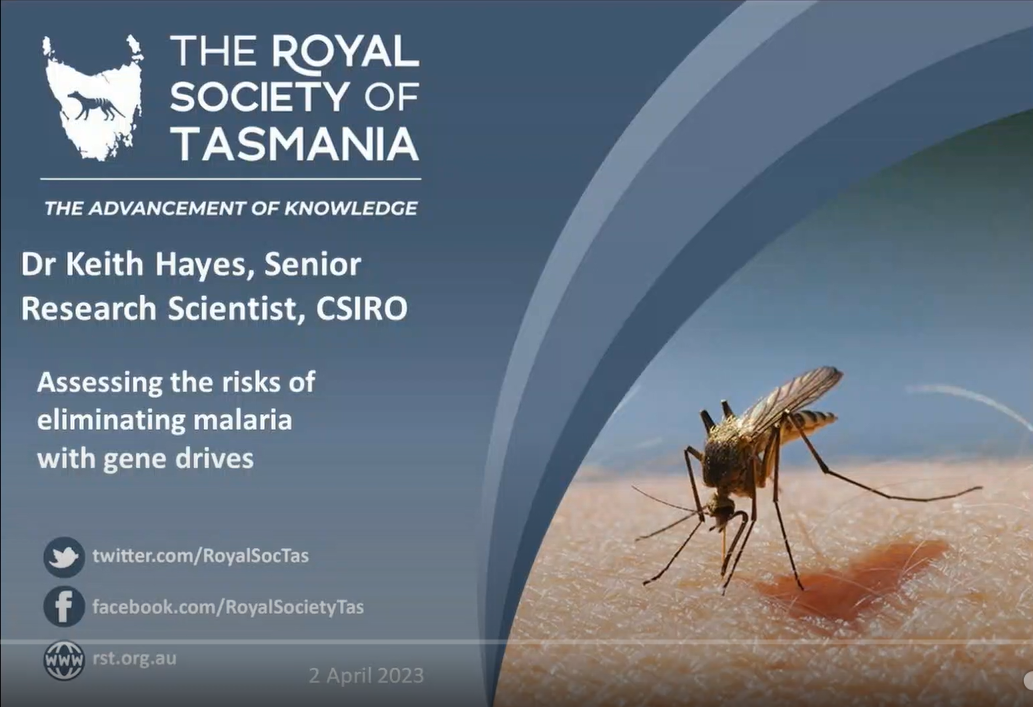
Assessing the risks of eliminating malaria with gene drives
Published: 02/04/2023
This is a The Royal Society of Tasmania Lecture given by Keith Hayes who is a is a senior research scientist at CSIRO Data61, and leads the Data61 Ecological and Environmental Risk Assessment (DEERA) team in the Hobart laboratories.
Synthetic gene drives cause significant deviations from Mendel’s Law of Equal Segregation, enabling specific genes to increase in prevalence in population’s of sexually reproducing organisms, even if these genes incur a fitness cost. In the laboratory gene drives have suppressed caged populations of human malaria vector mosquitoes in less than 12 generations (about 3 months) raising the prospect of a powerful new genetic method for eliminating malaria from regions such as Africa where the disease kills more than half a million people each year, 80% of which are children under five. In this presentation, Dr. Keith Hayes describes the methods used by his team to assess the environmental and human health risks associated with a strategy of staged-releases of genetically modified mosquitoes in Burkina Faso, designed to culminate in the first field trials of gene drive modified mosquitoes to eliminate malaria vector populations at a continent-wide scale.
Published: 02/04/2023
THEMES: Genetics and Genomics | Vector Control
Related Resources